
Loading…

Top 10 Slowest Fifties in ODI Cricket History (2026 Updated List!)
Scoring a half-century in One Day International (ODI) cricket is considered relatively easy.
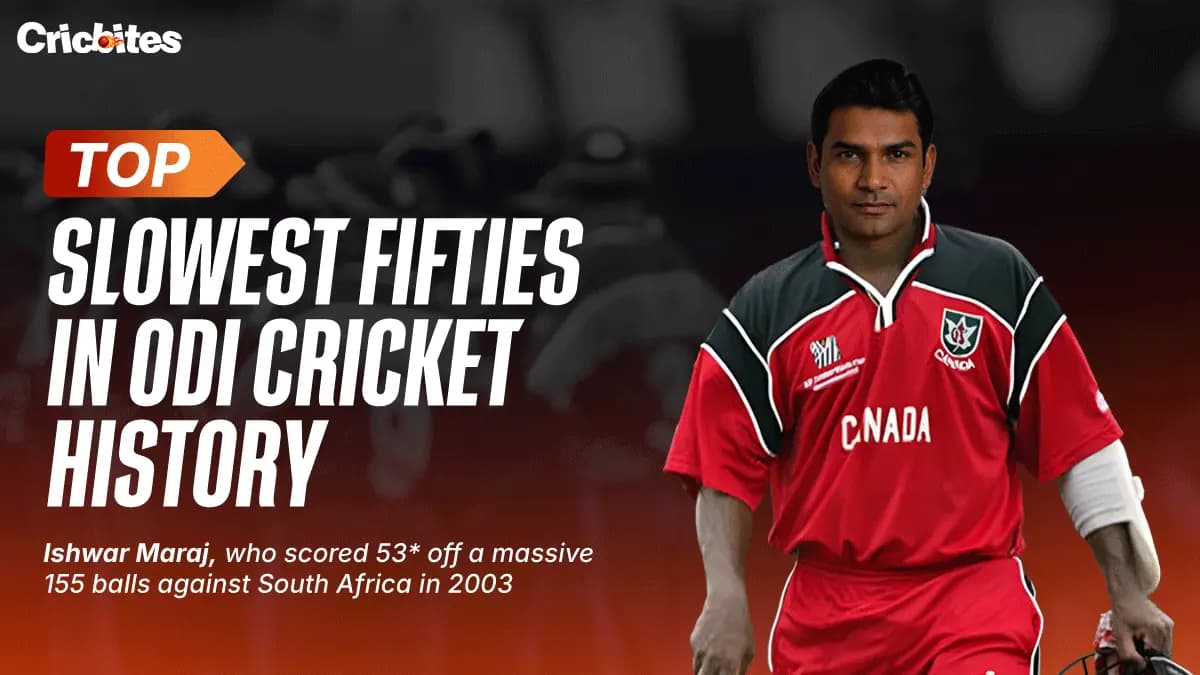
Scoring a half-century in One Day International (ODI) cricket is considered relatively easy. Well, it’s even easier now than it used to be. Bats are bigger these days. Boundaries are shorter. Fielding restrictions help the batsmen. A good player can now score fifty runs in thirty or forty balls. But not everyone plays by modern rules. Some batsmen take their time. They block the ball. They defend. They frustrate the bowlers, their teammates, and the fans. And eventually, it seems, they reach fifty runs. These are the slowest half-centuries in ODI cricket history. These aren’t moments of glory. These aren’t highlight reel material. Just a slow, painful process of accumulating runs. Some of these innings were played on difficult pitches. Some were tactical nightmares. Some players simply refused to give away their wicket despite having a bad day. Whatever the reason, these fifties tested patience more than skill. In a format designed for entertainment, these innings were anything but entertaining. But they happened. They are recorded. And they are worth remembering, if only as a reminder that cricket isn’t always beautiful. Sometimes, it’s just slow.
Slowest Fifties in ODI Cricket History
| Rank | Player | Team | Balls to Reach 50 | Opponent |
|---|---|---|---|---|
| 1 | Ishwar Maraj | Canada | 148 | South Africa |
| 2 | Javed Miandad | Pakistan | ~130+ | West Indies |
| 3 | DN Chudasama | Kenya | ~135 | Pakistan |
| 4 | Sunil Gavaskar | India | ~144 | New Zealand |
| 5 | Sidath Wettimuny | Sri Lanka | ~127 | Pakistan |
| 6 | Sadagoppan Ramesh | India | 116 | Kenya |
| 7 | MS Dhoni | India | 108 | West Indies |
| 8 | Sourav Ganguly | India | 105 | Sri Lanka |
| 9 | Sourav Ganguly | India | 104 | Bangladesh |
| 10 | Mohammad Kaif | India | 98 | New Zealand |
Ishwar Maraj (Canada) – 148 balls
In the 2003 World Cup, Canada faced South Africa’s formidable bowling attack, and what followed went down in the record books for all the wrong reasons. Opening the batting, Ishwar Maraj played an innings that remains the slowest fifty in ODI cricket history until 2026. He took 148 balls to reach the milestone and eventually finished unbeaten on 53 runs off 155 balls. A strike rate of just over 34 speaks for itself. This wasn’t batting as it’s conventionally understood; it was pure, unadulterated defiance. Against the South African attack, Maraj’s innings, however slow, became a statement of resistance. The fact that this record still stands nearly a quarter of a century later is a testament to the fact that this innings was played entirely on its own terms.
Javed Miandad (Pakistan) – approximately 130+ balls
In 1989, Pakistan faced the West Indies, and scoring runs was almost impossible. Javed Miandad, a master of grit and determination, anchored Pakistan’s innings with a defensive approach that was almost revolutionary. He remained unbeaten on 63 runs off 167 balls, an innings so slow that it was unusual even by the standards of that era. Although complete ball-by-ball data is not available, old records suggest that Miandad took over 130 balls to reach his half-century. This was classic Miandad, a batsman who preferred to spend the entire afternoon at the crease rather than give the opposition even the slightest chance. His half-century wasn’t pretty to watch, but in its own unique way, it was effective.
DN Chudasama (Kenya) – approximately 135 balls
Kenya’s DN Chudasama features prominently in the archives of slow-paced ODI batting from the mid-1990s. Facing Pakistan in the 1996/97 season, Chudasama batted for a considerable time under immense pressure. While a precise ball-by-ball record isn’t available, historical records consistently indicate that he reached his half-century in approximately 135 balls. For Kenya, a team still finding its feet in international cricket, such innings were like small victories. Chudasama’s half-century wasn’t meant to make a grand statement; it was simply to prove that Kenya deserved to be on the same playing field as the established cricketing powers. Sometimes, simply staying at the crease is enough to send a message.
Sunil Gavaskar (India) – approximately 144 balls
The great Indian opener, who revolutionized opening batting, scored one of the slowest fifties in ODI history against New Zealand in 1979. In the early years of limited-overs cricket, when the format itself was still evolving, Gavaskar’s primary focus was on staying at the crease. Match reports and old scorecards indicate that he took approximately 144 balls to reach his fifty. For Gavaskar, who grew up in the classical traditions of Test cricket, ODI batting was essentially Test batting against the clock. This particular fifty serves as a reminder that even legends of one era don’t always adapt easily to the demands of another. Yet, there is a certain dignity in the struggle itself.
Sidath Wettimuny (Sri Lanka) – approximately 127 balls
Sri Lanka’s Sidath Wettimuny crafted one of the slowest ODI half-centuries in history during a match against Pakistan in 1983. Facing disciplined bowling in challenging conditions, Wettimuny adopted such a cautious approach that it appeared incredibly slow. According to statistical records, he took approximately 127 balls to reach his fifty. For Sri Lankan cricket, which was in its nascent stages at the international level at the time, such innings were part of the learning process. Wettimuny was learning to survive at this level, and if it took 127 balls to score fifty runs, so be it. The history of cricket is built as much on such hard-fought efforts as it is on celebrated centuries.
Sadagoppan Ramesh (India) – 116 balls
India faced Kenya in 1999, and Sadagoppan Ramesh set a record that still stands today – the slowest verified ODI fifty by an Indian batsman. Ramesh’s innings, in which he took 116 balls to reach his half-century, is fully verified by ball-by-ball data, making it a firm entry in the record books. For a player whose international career never quite took off, this fifty became an unfortunate footnote. However, context matters. Perhaps wickets were falling, the conditions demanded caution, or the match situation required restraint. Easy explanations are rarely found in cricket.
MS Dhoni (India) – 108 balls
In a match against the West Indies in 2017, MS Dhoni, considered one of the greatest finishers of all time, scored one of the slowest half-centuries of his career. For a batsman who revolutionized limited-overs batting, scoring fifty runs off 108 balls seems almost impossible. However, the circumstances were challenging, wickets were falling, and Dhoni felt someone needed to anchor the innings. His fifty was the second slowest by an Indian in the ball-by-ball era. Even champion players have days when the runs don’t flow. Dhoni’s innings serves as a reminder that great players adapt to the situation rather than trying to impose their will on it.
Sourav Ganguly (India) – 105 balls
In 2005, against Sri Lanka, Sourav Ganguly carefully anchored the Indian innings. Facing disciplined bowling and limited support from his teammates, he prioritized stability over his natural aggression. Ball-by-ball records show that it took him 105 deliveries to reach his half-century. For a batsman known for his elegance and timing, this was a lesson in patience. As captain, Ganguly led by example, demonstrating that adaptability can sometimes be a leader’s most valuable asset.
Read More: Top 11 Best Finishers in IPL History 2025
Sourav Ganguly (India) – 104 balls
In 2007, against Bangladesh, Ganguly once again scored a slow half-century. Opening the innings, he struggled to find the boundary and relied heavily on singles and doubles. His fifty came off 104 balls, a fact confirmed by ball-by-ball data. These two entries in the list demonstrate that towards the end of his career, Ganguly was battling not only the opposing bowlers but also time itself. These weren’t his finest innings, but they showcase a champion who refused to give up.
Mohammad Kaif (India) – 98 balls
In 2003, India faced New Zealand, and Mohammad Kaif played a crucial innings under pressure. Runs were hard to come by, so Kaif focused on rotating the strike and preserving his wicket. He completed his half-century in 98 balls, one of the ten slowest verified ODI half-centuries in history. For Kaif, who was always more of a craftsman than a showman, this innings exemplified his philosophy: do whatever the team needs, regardless of how it looks.





Hello Readers! My name is Satyaki Das. I work as an SEO specialist and content writer at Cricbites.com and I have over 2 years of experience. I enjoy writing easy-to-read and engaging sports content, especially clear and helpful cricket stories for fans. I hope you enjoy my articles. Thanks for reading!